Berkshire
Bed Bug Heat Treatment in Berkshire: Understanding the Six-Month Guarantee
A practical guide to the six-month guarantee on qualifying bed bug heat treatments in Berkshire, with advice on access, preparation and reporting concerns.
7 October 20269 min read
40 years
In the trade
Four decades of hands-on bed bug experience
Fully insured
Every treatment
Comprehensive liability cover on all work
RSPH Level 2
Certificated
Royal Society for Public Health qualified
Key points
- A six-month guarantee applies to qualifying treatments.
- Confirm eligibility, scope and conditions in writing.
- Preparation and coordinated access support effective treatment.
- Report suspected activity promptly for assessment.
1. What the six-month guarantee means for Berkshire customers
When you arrange bed bug heat treatment, you want to understand both the treatment itself and what happens if concerns arise afterwards. Bed Bug Heat Solutions UK offers a six-month guarantee on qualifying treatments. The important word is qualifying: customers should establish whether their proposed treatment qualifies before deciding to proceed.
The six-month period gives the guarantee a defined duration, but it does not explain every part of the cover. The written terms should establish the treatment covered, the applicable dates and the process for raising a concern. Do not assume that a short description of the guarantee answers all of these questions.
This matters across Berkshire, where treatment may involve a family house, a commuter apartment or rooms within a busy hotel. Different properties have different access arrangements and occupancy patterns. The guarantee needs to be understood alongside the agreed treatment area, rather than treated as a general promise covering every room or neighbouring property.
A useful starting point is to ask for a clear explanation of the guarantee before booking. You should know which documents record the agreement and whom to contact afterwards. This article explains the practical questions to ask without replacing the written conditions that apply to your individual treatment.
2. Confirm qualification and scope before committing
The available house facts confirm a six-month guarantee on qualifying treatments, but they do not establish a universal set of eligibility rules. It would therefore be misleading to suggest that every booking automatically carries identical cover. Ask Bed Bug Heat Solutions UK to confirm qualification for your particular property and proposed treatment.
Be clear about the physical area included in the quotation. A treatment covering selected rooms is not the same agreement as one covering an entire property. In apartment buildings and hotels, a room number, flat number or floor description can help prevent misunderstandings about which spaces form part of the booking.
You should also establish what the guarantee provides if a reported problem falls within its terms. Do not assume that it automatically means a refund, an unrestricted number of visits or a particular follow-up procedure. Ask for the applicable process and any relevant limitations to be explained in plain language.
Keep the quotation, preparation instructions and guarantee terms together. If anything remains unclear, seek clarification before accepting the work rather than relying on an assumption. A written record is particularly helpful when a landlord, managing agent or hotel manager is arranging treatment on behalf of the people using the property.
- Confirm that the proposed treatment qualifies for the six-month guarantee.
- Check the exact rooms and areas included in the agreement.
- Ask for the guarantee start date and end date.
- Read the conditions and any exclusions before booking.
- Clarify how a concern is assessed and what covered follow-up involves.
- Keep the quotation and guarantee documents accessible.
3. Understand the heat treatment behind the guarantee
Bed Bug Heat Solutions UK uses controlled industrial heat of 60–65 degrees C across the whole treatment area. The heating period is usually three to six hours. These figures describe the treatment approach, but they should not be read as a promise that every property visit takes an identical amount of time.
The heating period is only one part of the practical arrangements. Access, equipment positioning, preparation checks and the instructions for returning to the property also need consideration. Ask what to expect for your booking, especially if you need to coordinate residents, housekeeping staff or other people with access responsibilities.
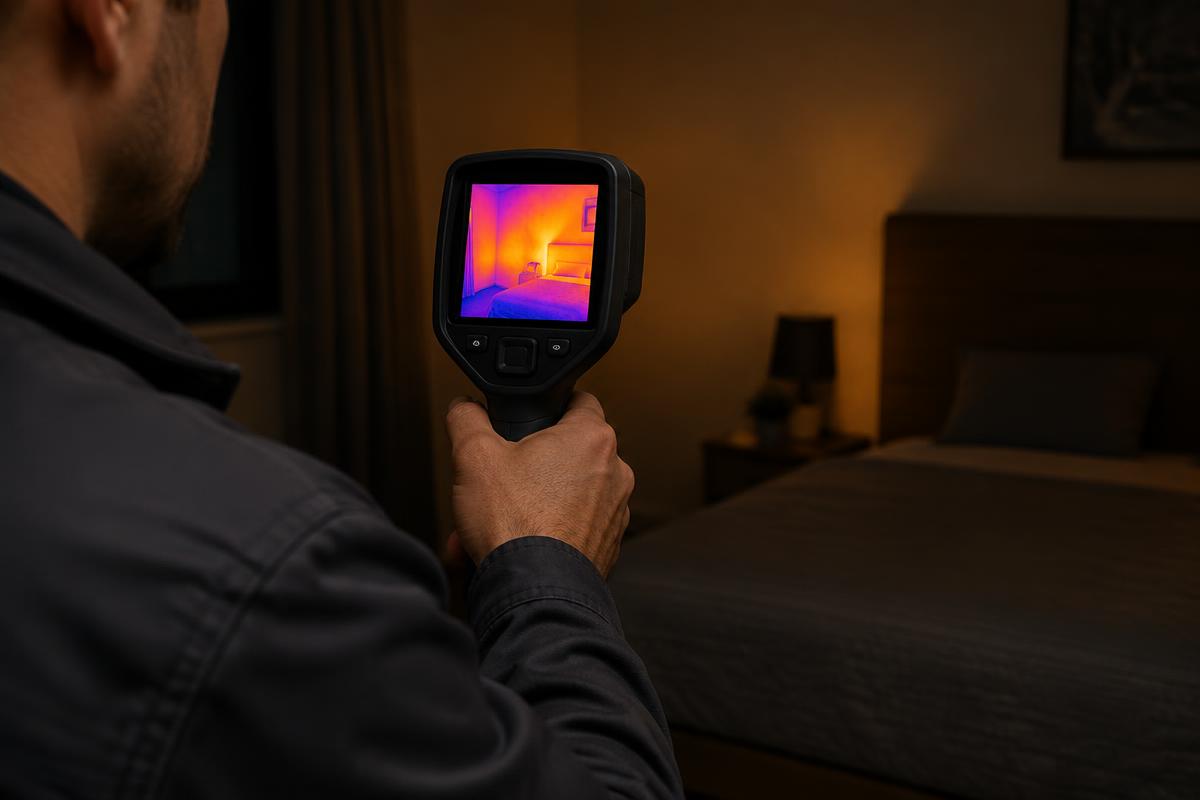
Monitoring uses active live thermal imaging cameras only. This supports observation of the treatment area's heat pattern while the work is under way. Monitoring and controlled heating are professional treatment activities; they are not a reason to attempt a similar process using domestic heaters or other improvised equipment.
No harmful chemicals are used as the primary treatment. That does not remove the need to follow safety and preparation instructions, including directions about people, pets and belongings. The guarantee sits alongside this planned treatment process; it is not a substitute for carrying out the work within an agreed, properly prepared area.
4. Treat preparation as part of the agreement
Preparation should be discussed early enough for you to ask questions and make realistic arrangements. Follow the instructions provided for your property rather than combining unrelated advice found online. Different recommendations can conflict, particularly over moving belongings, handling fabrics and protecting items that may be unsuitable for exposure to treatment heat.
Tell the treatment team about anything you are concerned could be affected by heat. Ask how those items should be managed before moving them elsewhere. Carrying potentially infested possessions into another room, vehicle or property can create additional problems, so removal should not be treated as an automatic or risk-free solution.
If you cannot complete a preparation task, explain this before the proposed treatment date. The team can discuss the situation and clarify how it affects the plan. Do not assume that an incomplete task automatically cancels the guarantee, but equally do not assume that preparation requirements are optional or unrelated to qualification.
For rented homes and managed accommodation, make sure the person receiving the instructions shares them with the people who must act on them. A tenant cannot follow guidance they have never seen. Clear communication reduces the chance of a booking proceeding with unresolved access, safety or preparation issues.
- Read the property-specific preparation instructions in full.
- Raise concerns about heat-sensitive belongings before moving them.
- Confirm the arrangements for residents and pets.
- Avoid moving potentially infested possessions without guidance.
- Tell the team about any preparation task you cannot complete.
- Share the instructions with everyone responsible for the property.
5. Coordinate Berkshire hotels and apartment access early
Berkshire's business centres, hotels, commuter apartments and family housing can present very different treatment logistics. Busy occupancy may leave little room for misunderstandings about which rooms are available. Early coordination helps establish a workable plan, particularly when several people control keys, room allocation, building access or the movement of equipment.
For a hotel or apartment block, identify the responsible contact before the proposed treatment date. This should be someone able to confirm the agreed arrangements and communicate with the relevant occupants or staff. Where responsibilities are shared, make clear who can authorise access and who should receive the treatment and guarantee documents.
Discuss loading arrangements and the route into the building, including any managed entrances or restrictions. These details do not determine guarantee cover by themselves, but they can affect whether the agreed work can proceed as planned. Raising them in advance is more useful than leaving the treatment team to resolve them on arrival.
Access to adjoining rooms should also be discussed before the proposed date. This does not mean that every neighbouring room necessarily requires treatment or is included under the guarantee. It means the team needs a clear account of the setting, any reported activity nearby and the practical options for assessment or further planning.
- Name the main contact responsible for coordinating the booking.
- Confirm who can provide keys and authorise room access.
- Agree loading arrangements and the equipment access route.
- Discuss access to adjoining rooms before the proposed date.
- Share relevant reports of suspected activity in nearby spaces.
- Make sure occupants and staff receive the agreed instructions.
6. Separate a treatment concern from possible reintroduction
One of the most important guarantee questions is how suspected activity after treatment will be assessed. An unresolved problem within the agreed treatment area is not necessarily the same situation as bed bugs being introduced later. The distinction can matter, but it should not be decided from assumptions or a single unexplained skin mark.
Bed bugs can travel with belongings, luggage and furniture. In buildings with several occupancies, activity elsewhere may also need consideration. None of this proves where a particular problem originated, and it should not be used to blame an occupant. It provides context for a careful discussion about what has been observed.
A six-month guarantee should not be interpreted as a promise that bed bugs can never enter the property again during that period. Equally, customers should not assume that every later sighting will automatically be classed as a new introduction. Ask how the written terms address these circumstances and what information supports an assessment.
If there have been changes since treatment, describe them factually. Relevant details might include recently introduced furniture, travel or reports from adjoining accommodation. Providing this information helps the team understand the situation; it does not establish, on its own, whether a concern is covered or what follow-up action is appropriate.
7. Report suspected activity clearly and promptly
If you suspect bed bugs after treatment, contact Bed Bug Heat Solutions UK promptly through the contact route provided in your booking documents or on the official website. Check whether your guarantee terms specify any reporting requirements. Do not leave a concern unreported while assuming that cover can be established without reference to the agreed dates.
Describe what you have seen, where you saw it and when it happened. Include the original treatment date and the affected room or area if available. A focused account is more useful than a broad statement that the treatment has failed, particularly when the first sign is uncertain or could have another explanation.
Clear photographs may help if you can take them without disturbing the area or spreading belongings. If a suspected insect can be safely contained, ask the team how they would like you to handle it. Skin reactions alone cannot reliably establish whether there is current bed bug activity or whether a guarantee applies.
Avoid starting additional treatments or moving potentially affected belongings between rooms before seeking advice. These actions can complicate assessment and may spread the problem. Explain any products or other measures already used, and ask about the next step without assuming a particular attendance time, remedy or guarantee decision.
8. Know what a guarantee assessment needs to establish
When a concern is raised, the practical questions include whether bed bugs are involved, where the signs have appeared and how the report relates to the original treatment agreement. The written guarantee determines the applicable process. A report should be considered on its circumstances rather than treated as proof of either treatment failure or customer error.
Keep the treatment paperwork available so that the relevant dates, address and agreed areas can be checked. For hotels and managed blocks, identify the precise room or apartment involved. If the concern relates to a space outside the original agreement, ask how it should be assessed rather than assuming it falls within existing cover.
Ask for a clear explanation of the proposed next step and whether it is covered by the guarantee. If any work outside the cover is suggested, request a separate explanation before authorising it. The existence of a guarantee does not establish fixed prices for additional work, nor does it remove the need for informed agreement.
Where there is uncertainty, ask what further information is needed and keep a record of the discussion. Calm, specific communication helps everyone work from the same facts. Do not assume a guaranteed response time or a particular outcome unless it is expressly included in the terms supplied for your qualifying treatment.
9. Keep useful records throughout the six months
After treatment, store the guarantee with the quotation and any written aftercare instructions. Note the applicable start and end dates rather than calculating them from memory. Having these details in one place makes it easier to raise a concern accurately and avoids confusion if the person who arranged the booking is unavailable.
Continue to follow the aftercare guidance you receive. If you are unsure about returning belongings, cleaning or arranging other work, ask before acting. Generic advice cannot replace instructions linked to your property, and the six-month guarantee should not be treated as permission to disregard the agreed approach after the heating period ends.
In a hotel or apartment building, maintain a straightforward handover between the people responsible for the accommodation. Relevant staff should know where the records are held and how to report a suspected sighting. They do not need to speculate about the source of a problem or make promises about cover on the company's behalf.
If responsibility for the property changes during the six months, check how this affects communication and any applicable guarantee terms. Do not assume the guarantee is transferable or that a new manager automatically has the information needed. Ask for clarification so that future concerns can be raised through the correct route.
10. Book with a clear understanding of the cover
A useful guarantee is one you can understand before you need it. For a Berkshire booking, the central questions are whether the treatment qualifies, which areas are covered, when the six months begins and what happens if suspected activity is reported. Clear answers are more valuable than broad assurances that leave the details unresolved.
Bed Bug Heat Solutions UK serves England and Wales, including Berkshire, and brings over 40 years of hands-on pest-control experience. The company is fully insured and RSPH Level 2 certificated. These credentials provide relevant background when choosing a professional provider, while the written agreement establishes the cover for your specific treatment.
Explain your property type, the signs you have found and any access restrictions when making an enquiry. For hotels and apartment blocks, include the responsible contact, loading arrangements and what is known about access to adjoining rooms. This information helps the discussion focus on a realistic treatment plan rather than an incomplete description of the site.
Before proceeding, request the preparation guidance and the terms of the six-month guarantee on qualifying treatments. Read them together and resolve any uncertainty about eligibility or follow-up. That approach gives you a practical understanding of the service, your responsibilities and how to seek help if concerns arise after treatment.
Useful next steps
Frequently asked questions
Six-month guarantee
Qualifying treatments are covered for six months. Send your details for a free assessment.
More from the blog
How Long Does Bed Bug Heat Treatment Take?
Read the full guide: How Long Does Bed Bug Heat Treatment Take?