Cambridgeshire
Bed Bug Heat Treatment in Cambridgeshire: A Guide for Landlords, Tenants and Shared Homes
A practical guide to planning bed bug heat treatment in Cambridgeshire rentals, with clear advice on shared rooms, tenant communication and access.
28 September 202610 min read
40 years
In the trade
Four decades of hands-on bed bug experience
Fully insured
Every treatment
Comprehensive liability cover on all work
RSPH Level 2
Certificated
Royal Society for Public Health qualified
Key points
- Report suspected activity early and avoid moving belongings between rooms.
- Plan the treatment zone around occupancy, room changes and property layout.
- Coordinate access and preparation across everyone affected.
- Qualifying treatments include a six-month guarantee.
Bed bugs in Cambridgeshire rental properties
Bed bugs can create a difficult situation in any rented home, particularly when several people share the property. A tenant may be worried about bites, a landlord may need to arrange access, and other occupants may not know whether their rooms are affected. A calm, coordinated response is more useful than blame or hurried disposal of furniture.
In Cambridgeshire, university accommodation, shared rentals, city apartments and rural homes can present very different access and occupancy challenges. A compact flat may have limited space for preparation, while a larger shared house may have several locked bedrooms. These differences matter when deciding what needs to be assessed and how treatment can be organised.
Bed Bug Heat Solutions UK provides professional bed bug heat treatment across England and Wales, including Cambridgeshire. We use controlled industrial heat of 60–65°C across the whole treatment area, with a heating period usually lasting 3–6 hours. No harmful chemicals are used as the primary treatment, and monitoring uses active live thermal imaging cameras only.
For landlords and tenants, effective planning starts with an accurate account of the property and what has happened inside it. The number of bedrooms alone does not define the treatment zone. Sleeping arrangements, reported activity, shared spaces and the movement of belongings all help establish which areas should be assessed before a treatment plan is agreed.
Recognising a concern and reporting it clearly
Suspected bed bug activity should be reported promptly, but skin marks alone do not confirm an infestation. Bites can resemble other skin reactions, and people respond differently. More useful evidence can include a suspected live insect, shed skins or dark spotting around sleeping areas. Professional assessment helps avoid treating the wrong problem or overlooking the true extent of activity.
Tenants should give the landlord, managing agent or accommodation team a clear written report. Explain which room is involved, when the signs were first noticed and whether anyone has recently started sleeping elsewhere. If it is safe to do so, take a clear photograph of a suspected insect rather than disturbing furniture or spreading belongings around the property.
Landlords should acknowledge the concern without assuming that the person reporting it introduced the bed bugs. It is often difficult to establish where an infestation began. Focusing first on evidence, access and assessment allows practical work to move forward while any questions about responsibilities or payment are considered separately.
In a shared home, one person should coordinate the information without filtering out details from other residents. A short record of sightings, affected rooms and changes in sleeping arrangements is useful. It should describe what people have actually observed, rather than treating every bite or unexplained mark as proof that a particular room is infested.
- Record the rooms where suspected activity has been noticed.
- Note when each concern was first reported.
- Photograph suspected insects or visible signs where practical.
- Explain any recent changes in sleeping arrangements.
- Tell the coordinator about belongings moved between rooms or addresses.
- Keep reports factual and share them only with people who need them.
Agreeing responsibilities without delaying assessment
Responsibility for arranging or paying for treatment is not automatically the same in every tenancy. Relevant factors may include the tenancy agreement, the condition of the property at the start of occupation and the circumstances of the infestation. A general article cannot decide liability for an individual case, so avoid relying on a blanket rule about landlords or tenants.
The immediate practical question is who will authorise assessment and coordinate the work. In a privately rented home, this may be the landlord or managing agent. In university accommodation, it may be an accommodation office or facilities team. Residents should use the relevant reporting process and make sure that an authorised person receives the information.
If costs are disputed, keep correspondence and evidence while seeking appropriate housing advice. Shelter, Citizens Advice or the local council's housing team may be able to explain the relevant considerations. A disagreement about payment should not lead to occupants moving potentially affected belongings elsewhere without advice, as that can make the situation more complicated.
Written arrangements help everyone understand the next steps. Confirm who is liaising with the treatment company, who is providing access and who will pass preparation instructions to residents. Tenants should also know where to raise practical concerns, especially if work patterns, disability, caring responsibilities or temporary absence make the proposed arrangements difficult.
Defining a sensible treatment zone in shared housing
The treatment zone should reflect the property details, not simply the room where the first complaint was made. In a shared rental, residents may use more than one sleeping space or store belongings in communal areas. Understanding these patterns helps identify the rooms that should be assessed and reduces the risk of planning around an incomplete picture.
If occupants have changed rooms or moved belongings between addresses, explain this when enquiring. A mattress moved to another bedroom, bags taken to a partner's home or stored possessions returned from another address may alter the rooms that should be assessed. These details are relevant even when the move happened before anyone recognised the signs of bed bugs.
Avoid treating a change of sleeping room as a solution. Moving bedding and possessions can transfer bed bugs to another area, and sleeping elsewhere may complicate assessment. Ask for advice before moving items out of the suspected area. Shared lounges used for sleeping, guest rooms and other regularly occupied spaces should be mentioned during the enquiry.
A whole-house treatment is not something to assume from a brief description, and neither is a single-bedroom treatment. We use the available information to define a sensible treatment zone. Where relevant, the landlord or building manager may also need to consider assessment of adjoining accommodation, while respecting the privacy and access rights of other occupants.
Coordinating access in apartments, shared houses and rural homes
Access planning can be a significant part of treatment in Cambridgeshire. A city apartment may involve communal entrances, stairs, lifts and building management arrangements. A shared house may have separately locked rooms and residents working different shifts. Rural homes may have different parking or access constraints. Explain the actual arrangements rather than assuming the postcode tells the whole story.
Landlords and agents should arrange access through the proper tenancy process and agree practical details with residents. Do not assume that permission to enter one room covers every bedroom or private area. If access is needed to several occupied rooms, confirm those arrangements before the visit so that the agreed treatment zone is not unexpectedly restricted.
University accommodation can involve separate responsibilities for room access, communal areas and resident communications. It helps to establish who can authorise the work and who will coordinate with students. Where occupants are away, the accommodation provider should confirm the lawful access arrangements and ensure that any preparation requirements can still be completed.
Residents need an agreed plan for being outside the treatment area, including arrangements for pets and anyone requiring assistance. Ask about likely overall disruption rather than using the heating period as a return time. Setup, assessment, preparation checks and the process for allowing re-entry also need to be taken into account.
- Identify the person authorised to agree the work.
- Explain communal entrance, stair and lift arrangements.
- Confirm access to each room within the agreed treatment zone.
- Provide relevant parking and equipment access information.
- Raise mobility, care, pet or other occupancy needs in advance.
- Agree how residents will receive updates and re-entry instructions.
Preparing rooms without spreading the problem
Preparation should follow the instructions provided for the property and the agreed treatment zone. General advice found online may not suit the planned work. Before residents start packing, emptying cupboards or moving furniture, make sure they have the same instructions and understand which tasks apply to their own rooms and to shared spaces.
Do not automatically take bags of clothing, bedding or other possessions to a different address. Potentially affected items can carry bed bugs with them. Where items need to be removed, protected or handled separately, ask for clear directions on containment and the appropriate next step. Unplanned removal can leave important belongings outside the treatment plan.
Heat-sensitive possessions and safety concerns should be discussed before the visit. Tell us about medicines, aerosols, batteries, electronics, valuable items and anything with specific storage requirements. Do not assume that every item must be removed or that every item can remain. Follow the property-specific guidance rather than making decisions based only on broad categories.
Shared housing needs a preparation coordinator, but that does not mean one tenant should handle everyone else's belongings. Each occupant should understand their own tasks, while the landlord or agent checks that communal responsibilities are covered. Any uncertainty or incomplete preparation should be reported before treatment rather than left for the team to discover on arrival.
- Distribute the same preparation instructions to all affected residents.
- Ask before moving furniture or belongings out of the treatment zone.
- Declare items with heat sensitivity or special storage requirements.
- Agree responsibility for preparing communal spaces.
- Keep agreed equipment and working access routes clear.
- Report any preparation task that cannot be completed.
How professional heat treatment is managed
Our primary treatment uses controlled industrial heat of 60–65°C across the whole treatment area. This is a planned professional process, not simply a matter of making a room feel hot. Property layout, contents and the agreed scope all inform how the work is organised, which is why accurate information and suitable preparation are important.
The heating period usually lasts 3–6 hours. That is a typical range, not an exact appointment length or a guaranteed completion time for every home. Residents should not arrange their return solely by counting hours from arrival. The team will explain the relevant arrangements and tell occupants when the treatment area can be re-entered.
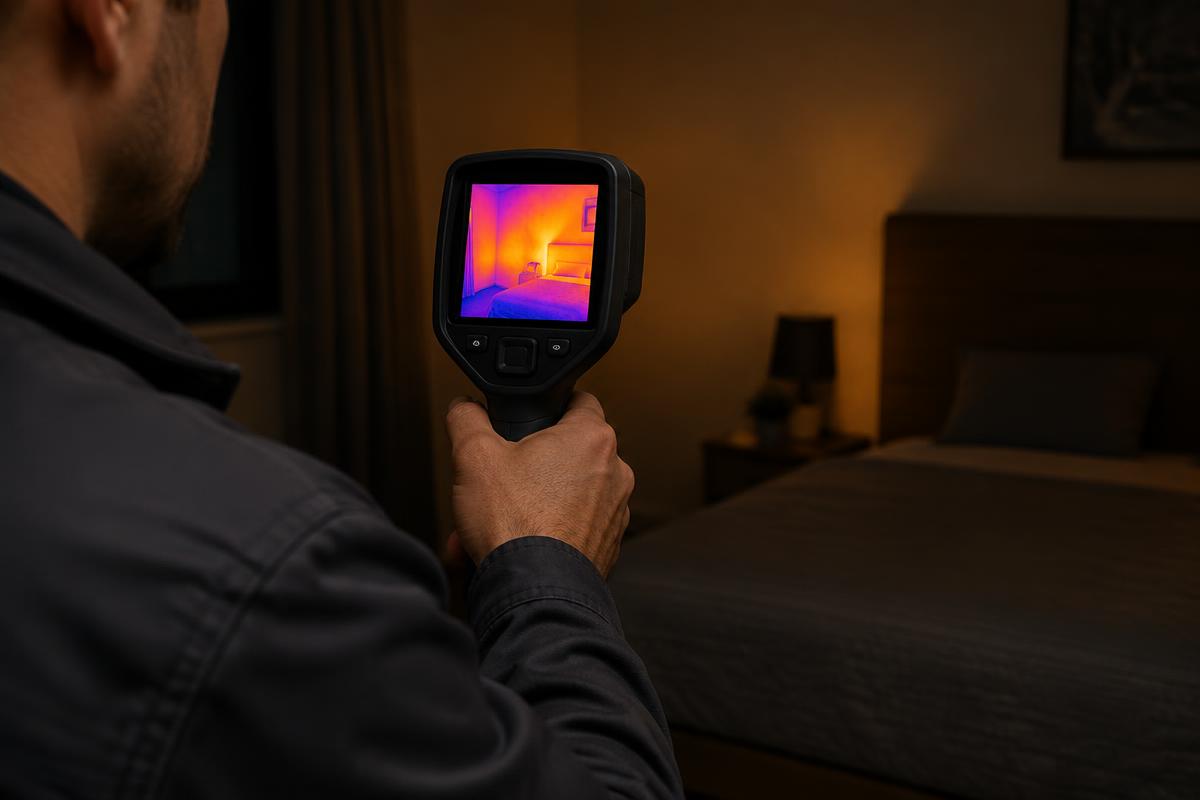
Monitoring uses active live thermal imaging cameras only. These provide live thermal views of the treatment area to support management of the heating process. Residents should not enter to check progress themselves or interfere with the equipment. Questions and any changes to access arrangements should go through the agreed contact person.
No harmful chemicals are used as the primary treatment, but professional heat treatment still requires safety controls and clear instructions. People and pets must remain outside the treatment area as directed. Do not try to reproduce the process with domestic heaters or improvised equipment, which can create fire risks without providing a properly managed treatment.
Keeping tenants informed and protecting privacy
Bed bug reports can feel embarrassing, particularly in a house where residents do not know one another well. Clear, neutral communication makes it easier for people to report concerns and follow instructions. Bed bugs are not proof of poor cleanliness, and blaming an individual can discourage disclosure of room changes or sightings that are important to the assessment.
Residents need practical information about the treatment zone, preparation, access and temporary absence. They do not necessarily need personal details about who first reported bites or where another tenant has been staying. Landlords and accommodation teams should share what is necessary to organise the work while keeping private information appropriately restricted.
A single written update can prevent conflicting messages in a busy shared household. Set out what has been agreed, which actions remain outstanding and how questions should be raised. If the plan changes, make sure every affected occupant receives the revised instructions rather than relying on one resident to pass them on informally.
Where someone has difficulty understanding the instructions, address this before treatment. Plain explanations, accessible communication or support from an authorised representative may help. It is better to identify a practical barrier early than to assume silence means agreement, particularly when access to a private room or handling of personal possessions is involved.
Aftercare, ongoing reports and the six-month guarantee
Once treatment is complete, follow the team's re-entry and aftercare instructions. Do not immediately bring back belongings that were excluded from the treatment zone unless their handling has been agreed. In shared homes, the same approach needs to apply across residents so that one person's stored possessions do not fall outside the overall plan.
Keep a factual record of any later concerns, including the date, room and evidence observed. Skin reactions alone are not a reliable way to determine whether bed bugs remain. If you find a suspected insect or fresh signs, contact the company for advice rather than adding unplanned sprays, moving rooms or discarding furniture.
Bed Bug Heat Solutions UK offers a six-month guarantee on qualifying treatments. Eligibility and the applicable terms should be confirmed before booking. Do not assume that every partial treatment or every later report is automatically covered. Understanding the agreed scope and guarantee conditions helps landlords and tenants know what to do if a concern arises.
New occupants, returning belongings and changes in room use should still be managed carefully after treatment. No service can stop bed bugs being introduced again through future movement of infested items. Keeping treatment records, preparation guidance and the guarantee information together gives the property manager a clear reference if the tenancy or household membership changes.
Arranging bed bug heat treatment in Cambridgeshire
A useful enquiry starts with the property type, location, number of bedrooms and current occupancy. Tell us whether it is a privately rented home, shared house, apartment or university accommodation. Explain where activity has been reported, whether there are locked rooms and who has authority to agree access and treatment.
Also describe any changes in sleeping arrangements and movement of belongings between rooms or addresses. Include relevant access limitations and any residents who may need additional support with preparation or temporary absence. These details help us discuss a sensible assessment and treatment scope without making assumptions about how the property is used.
Bed Bug Heat Solutions UK brings over 40 years of hands-on pest-control experience to the work. We are fully insured and RSPH Level 2 certificated, serving properties across England and Wales. Our approach combines professional heat treatment with clear preparation and access arrangements suited to the home and the people living there.
For a Cambridgeshire landlord, tenant or accommodation manager, the next step is to make an enquiry with those property details. We can discuss the proposed treatment zone, preparation requirements and whether the six-month guarantee applies. A coordinated plan gives everyone a clearer understanding of their responsibilities and avoids preventable disruption caused by missing information.
Useful next steps
Frequently asked questions
Six-month guarantee
Qualifying treatments are covered for six months. Send your details for a free assessment.
More from the blog
How Long Does Bed Bug Heat Treatment Take?
Read the full guide: How Long Does Bed Bug Heat Treatment Take?