Leicestershire
Bed Bug Heat Treatment in Leicestershire: What to Expect on Treatment Day
A practical guide to treatment day in Leicestershire, including preparation, access, monitored heating, safe re-entry and aftercare.
16 October 20269 min read
40 years
In the trade
Four decades of hands-on bed bug experience
Fully insured
Every treatment
Comprehensive liability cover on all work
RSPH Level 2
Certificated
Royal Society for Public Health qualified
Key points
- Share room changes and movements of belongings before treatment.
- The heating period usually lasts 3–6 hours, with additional time for setup and cooling.
- Monitoring uses active live thermal imaging cameras only.
- Qualifying treatments include a six-month guarantee.
1. Understanding the plan for your Leicestershire property
Treatment day should begin with a clear understanding of what will happen, which areas are included and what you need to do. Bed Bug Heat Solutions UK uses controlled industrial heat of 60–65°C across the whole treatment area. The heating period usually lasts 3–6 hours, but this is not the total appointment duration.
Time is also needed to review the property, complete safety checks, position equipment and allow cooling before re-entry. The practical arrangements depend on the rooms involved, their contents and the agreed treatment scope. Avoid planning your return around the heating period alone, and discuss any access restrictions before the day.
Leicestershire properties vary considerably. Leicester student houses may have several independently occupied bedrooms, while suburban family homes often have belongings shared between rooms. County hotels have guest turnover and housekeeping movements to consider. These occupancy patterns are discussed during assessment rather than treated as interchangeable situations.
The assessment helps establish a workable plan, but you should still report anything that has changed since the booking. A newly affected room, an overnight guest or furniture moved into storage may matter. Clear information at the outset helps the team check that the planned treatment area remains appropriate.
2. Explaining where people and belongings have moved
One of the most useful things you can provide is a straightforward history of where people have slept and where belongings have travelled. If someone moved from the first reported bedroom to a sofa or another bedroom, say so. This can help identify potential spread beyond the original sleeping area.
Mention bedding, bags, clothing or furniture taken to another property, a vehicle, a laundry room or temporary accommodation. You do not need to determine whether those items carried bed bugs. The purpose is to give the team enough information to assess relevant movements and advise on what needs further attention.
In shared housing, ask occupants to contribute their own room histories where possible. One tenant may have noticed insects while another has quietly changed bedrooms. In a hotel, room changes and the movement of guest luggage or housekeeping equipment may be relevant. Handle these discussions discreetly without assigning blame.
Avoid moving more belongings simply to make the affected room look clearer. Unplanned transfers can complicate the assessment and leave potentially affected items outside the agreed treatment area. If something must be moved for safety or access, explain what it is and ask how to handle it before doing so.
- Identify every room where bed bugs or possible signs have been noticed.
- Explain any recent changes in sleeping arrangements.
- Report bedding, bags or furniture taken into other rooms.
- Mention belongings taken to another property or vehicle.
- Describe any pest-control products or treatments already used.
- Tell the team about changes since the original assessment.
3. Preparing without disrupting the treatment plan
Follow the preparation instructions supplied for your property rather than combining advice from unrelated online guides. Heat treatment requires careful planning around room contents and access. Instructions that suit a chemical application or an ordinary deep clean may not suit the heat-treatment arrangement agreed for your home or business.
Tell the team about medicines, aerosols, pressurised containers, candles, valuable artwork and other potentially heat-sensitive possessions. These examples are not a complete removal list. The team should advise which items need special handling, which should remain and how any necessary removals can be managed without overlooking possible bed bug activity.
Do not assume that every cupboard must be emptied or every item of furniture dismantled. Unnecessary sorting can take considerable time and move belongings away from where they were assessed. Ask for clarification if instructions are unclear, especially where built-in storage, bulky furniture or large quantities of clothing are involved.
Preparation should also account for people and animals. Explain any mobility needs, medical equipment, aquariums or other circumstances that could affect leaving the property or handling its contents. Arrange a suitable place to wait and keep essential items accessible, following the team's advice about taking possessions out with you.
- Read the property-specific preparation instructions before treatment day.
- Ask about heat-sensitive items rather than removing them without advice.
- Keep agreed access routes clear.
- Arrange suitable accommodation for pets during the work.
- Discuss medical equipment and accessibility requirements in advance.
- Plan where occupants will wait until re-entry is authorised.
4. What happens when the team arrives
On arrival, the team will need access to the agreed rooms and relevant parts of the property. Be ready to explain entry arrangements, locked doors and any restrictions that were discussed during booking. In a managed building, identify who can authorise access if a question arises while work is underway.
A walkthrough provides an opportunity to confirm preparation and point out any recent findings. Show the team where insects or signs were noticed, rather than moving affected items to demonstrate them. Photographs or a safely contained specimen, if already available, may help the discussion without requiring further disturbance of the room.
The team will review practical safety matters and the planned equipment arrangement before heating begins. If preparation is incomplete or an unexpected concern appears, additional action may be necessary. It is better to resolve that issue openly than to continue with an assumption about something that affects safe treatment.
This is also the time to confirm how updates will be provided and who will receive the handover. For rented accommodation or a hotel, the person booking may not be present throughout. Agree a responsible contact so that decisions about access, outstanding questions and eventual re-entry reach the right person.
5. Setting up controlled industrial heat
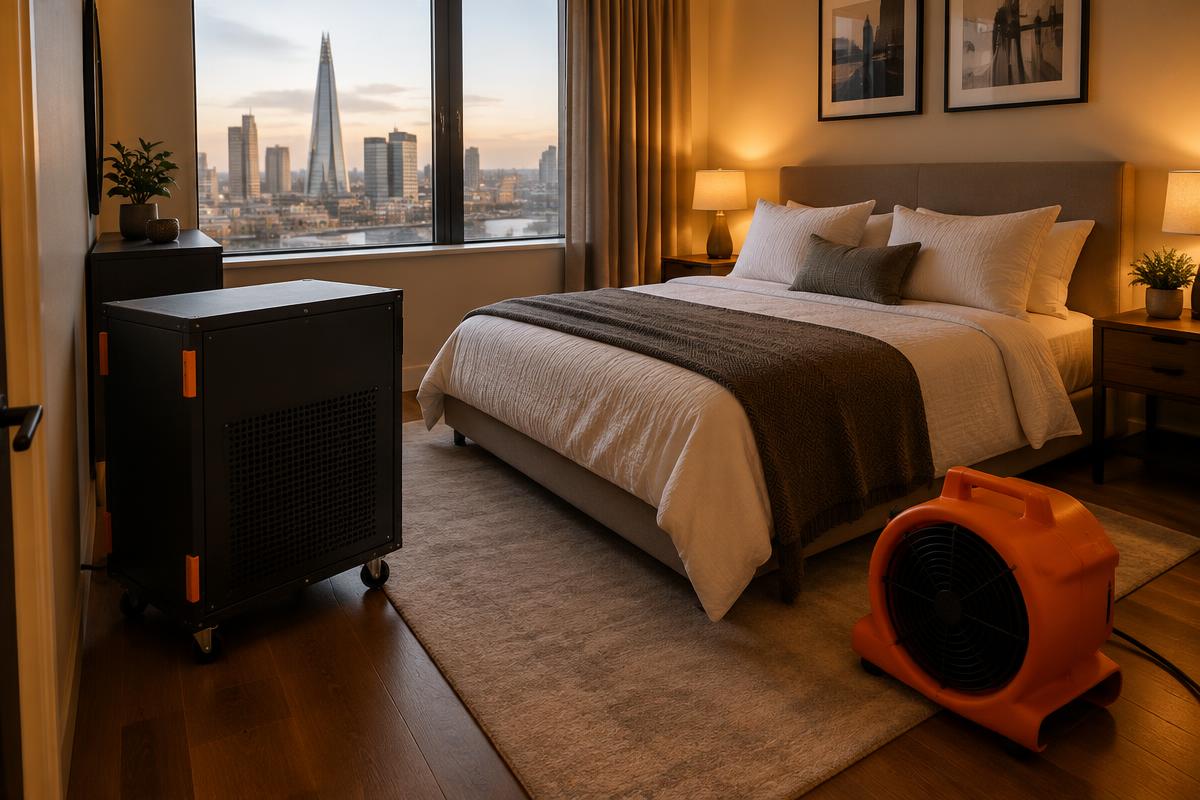
Professional heat treatment involves more than making a bedroom feel hot. Equipment is positioned to deliver controlled industrial heat across the whole treatment area, with attention to room layout and the distribution of contents. The agreed area matters because bed bugs are not necessarily confined to the bed where they were first noticed.
Bed Bug Heat Solutions UK works with treatment temperatures of 60–65°C. Heat is the primary treatment, rather than harmful chemicals. This does not remove the need for precautions: elevated temperatures and operating equipment create a controlled work area that occupants should not enter unless the team has expressly authorised it.
Furniture, stored items and room configuration can influence how heat moves through a space. The team may need to make agreed adjustments to support the treatment process. Do not rearrange equipment, close doors or change the layout after setup, as apparently minor alterations can interfere with the planned distribution of heat.
A whole treatment area is not automatically the same thing as an entire building. The scope should be agreed through assessment and clearly explained. If a home, shared house or hotel has rooms outside that scope, ask how they have been considered and whether further assessment or coordinated action is needed.
6. Monitoring with active live thermal imaging
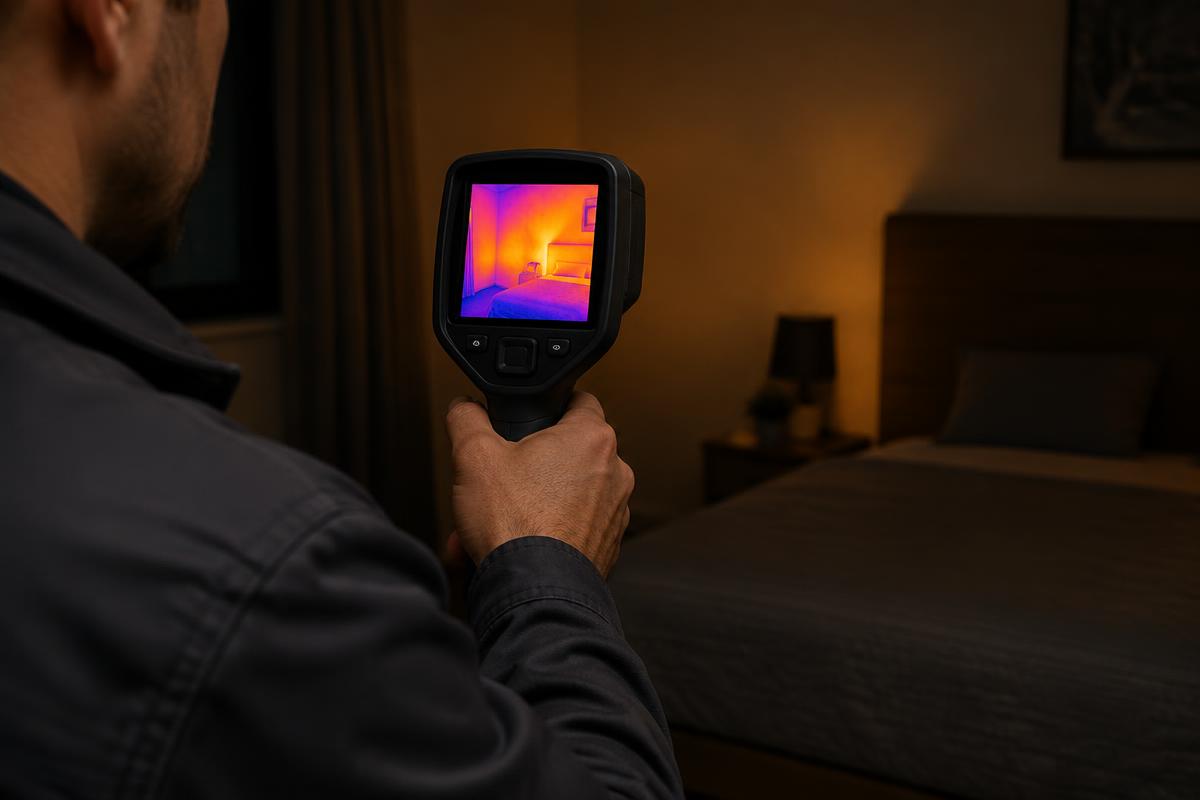
Monitoring uses active live thermal imaging cameras only. These allow the team to observe thermal patterns during treatment and review how visible surfaces are responding to heating. Monitoring is an active part of the work, rather than an assumption that switching on equipment will produce suitable conditions everywhere without supervision.
Thermal imaging helps inform attention to heat distribution and areas that may warrant adjustment. However, a thermal image should not be described as seeing through every object or proving that an individual insect has died. Professional judgement, the treatment plan and appropriate heat exposure remain important alongside the information visible on camera.
The heating period usually lasts 3–6 hours. The layout, contents and conditions encountered on the day influence how the process is managed. That usual range should not be interpreted as a fixed finish time or permission to return at a particular hour without confirmation from the team.
While treatment is underway, remain available through the agreed contact arrangement but stay outside the restricted area. If you realise that something important has been left behind, contact the team rather than entering to retrieve it. They can explain whether it can be accessed safely or must wait until later.
7. Managing the day in shared homes and hotels
In Leicester student and shared housing, coordination can be as important as individual preparation. Everyone whose room is included needs to understand the access and absence arrangements. A single point of contact can help, but it should not replace clear instructions for each affected occupant about belongings and when they may return.
If bedrooms have separate locks, confirm that authorised access is available before the appointment. Tell the team about occupants who work nights, travel regularly or may be away during preparation. These are practical planning details, not reasons to assume that a room is unaffected or can be left out without assessment.
For suburban family homes, consider school routines, home working and caring responsibilities. Arrange the day so that nobody depends on entering the treatment area while heating is in progress. If temporary arrangements involve staying elsewhere, seek advice on which essential belongings to take and how to manage them.
County hotels may need to coordinate room availability, guest communications and housekeeping activities. Report recent guest room changes and relevant movements of luggage or room contents. Avoid transferring items from an affected room into another guest room as an improvised solution, and agree how neighbouring or connected spaces will be considered.
8. Cooling, handover and safe re-entry
The end of the heating period does not automatically mean the area is ready for normal occupation. Cooling and safety checks form part of the process. Wait for explicit re-entry guidance, and do not use the appearance of switched-off equipment or an open doorway as a substitute for authorisation.
At handover, ask what has been completed and whether any issues require follow-up. This is your opportunity to confirm the treated area, understand the advice for belongings that were excluded and clarify what happens next. If someone else receives the handover, make sure the information reaches all relevant occupants.
Some contents may remain warm as the property returns to normal conditions. Follow the team's advice about handling items and resuming ordinary use of the rooms. Keep children and pets away until their return has been cleared, and do not attempt to speed up the process by changing arrangements without permission.
Before the team leaves, confirm how to report a concern and what information would be helpful. Knowing the next step can prevent unnecessary spraying, furniture disposal or room changes. Ask about guarantee eligibility and any conditions attached to your treatment, rather than assuming every booking carries identical terms.
- Wait for explicit permission before re-entering the treatment area.
- Confirm which rooms and areas were treated.
- Ask about any excluded possessions that need further action.
- Share handover instructions with other occupants.
- Check the aftercare and guarantee terms supplied for your booking.
- Keep the agreed contact route available for follow-up concerns.
9. What to watch for after treatment
Follow the aftercare instructions supplied rather than starting a separate treatment routine immediately. Unplanned insecticide use or moving back into a previously unused bedroom can make later observations harder to interpret. If you are uncertain about cleaning, laundry or replacing items, ask before taking action that changes the assessed situation.
Skin marks alone are not a reliable way to confirm continuing bed bug activity. Reactions vary, may be delayed and can have other causes. Report concerns calmly, but try to provide more specific observations where possible, such as a photograph of an insect and the room and date in which it was found.
If a live suspected bed bug is seen, contact the company for advice rather than assuming either that nothing can be done or that every room needs immediate treatment. Record where it appeared and mention any belongings recently returned from elsewhere. This information helps guide a sensible review of the circumstances.
Qualifying treatments include a six-month guarantee. Eligibility, conditions and the process for requesting assistance should be checked against the terms provided for your booking. A guarantee is not a promise that bed bugs can never be brought into a property again, so continued care around incoming belongings remains worthwhile.
10. Booking with clear expectations
A useful booking conversation focuses on the property and the practical work needed, not simply the number of beds. Explain the rooms affected, who uses them and what evidence has been found. Include previous treatment attempts and any movement of people or belongings so that the assessment starts with an accurate picture.
Bed Bug Heat Solutions UK serves Leicestershire as part of its coverage across England and Wales. The company brings over 40 years of hands-on pest-control experience, is fully insured and holds RSPH Level 2 certification. These credentials sit alongside clear preparation advice and an agreed treatment scope, rather than replacing them.
Ask what the proposed service includes, what you need to arrange and whether the six-month guarantee applies. Discuss any limits on access or availability before agreeing the appointment. Costs and scheduling should reflect the assessed work; neither an exact completion time nor a universal price should be assumed from a general article.
The best preparation for treatment day is a shared understanding of the plan. Provide an honest movement history, follow the instructions, remain available for questions and wait for clearance before returning. Those straightforward steps help the team carry out controlled heat treatment safely and leave you with clear guidance for the days that follow.
Useful next steps
Frequently asked questions
Six-month guarantee
Qualifying treatments are covered for six months. Send your details for a free assessment.
More from the blog
How Long Does Bed Bug Heat Treatment Take?
Read the full guide: How Long Does Bed Bug Heat Treatment Take?