London
Bed Bug Heat Treatment in London: How the Six-Month Guarantee Works
Learn what to check about the six-month guarantee on qualifying London bed bug heat treatments, from the agreed treatment area to reporting later concerns.
21 October 20269 min read
40 years
In the trade
Four decades of hands-on bed bug experience
Fully insured
Every treatment
Comprehensive liability cover on all work
RSPH Level 2
Certificated
Royal Society for Public Health qualified
Key points
- The six-month guarantee applies to qualifying treatments.
- Confirm the written scope and conditions before booking.
- London building layouts make assessment especially important.
- Report later signs promptly rather than assuming treatment has failed.
What the six-month guarantee means for a London property
A six-month guarantee is an important consideration when arranging bed bug heat treatment, but its value depends on understanding exactly what it covers. Bed Bug Heat Solutions UK offers a six-month guarantee on qualifying treatments. That qualification matters: the guarantee should be read alongside the proposed treatment, the areas included and the written conditions supplied for your booking.
London properties often need particularly careful planning. Flats, converted houses, hotels and frequently occupied accommodation can have adjoining rooms, shared entrances and a steady movement of people or belongings. A room-by-room assessment helps establish an appropriate treatment area rather than relying only on where someone first noticed bites or found an insect.
Practical access details should also be shared early. Restricted parking, controlled entrances, lifts and concierge arrangements can affect how treatment equipment reaches the property. Explaining these details before the visit allows planning around the building, rather than discovering an avoidable obstacle when the team arrives.
The guarantee is not a promise that bed bugs can never enter the property again. It is a commitment governed by the terms of a qualifying treatment. Before booking, establish whether your proposed work qualifies, what happens if concerns arise during the six months and which circumstances are covered or excluded.
Confirm eligibility and written terms before booking
The first question is straightforward: does the treatment proposed for your property qualify for the six-month guarantee? Do not assume that every possible booking or treatment arrangement has identical cover. Ask for confirmation against your own quotation, particularly if you are requesting treatment of selected rooms rather than all potentially affected areas.
Next, check when the six-month period begins and how that date will be recorded. The general offer alone does not establish the administrative details of an individual booking. A written start date and a clear description of the covered property or rooms make the guarantee easier to understand if you need to refer to it later.
It is equally important to establish what the company will do if a concern is accepted under the guarantee. A six-month guarantee does not, by itself, tell you whether an inspection, further treatment or another response is included. Ask which actions are covered and whether any circumstances could lead to additional charges.
Read the terms before authorising work, and raise anything that seems unclear. This article explains how to approach the guarantee, rather than replacing the conditions issued for your treatment. Keeping the quotation, preparation instructions and guarantee details together gives you a useful reference throughout the six-month period.
- Confirm that the proposed treatment qualifies.
- Request the guarantee start date in writing.
- Check which rooms and areas are covered.
- Ask what action is included if a claim is accepted.
- Clarify exclusions and any possible additional charges.
- Keep the booking documents and written conditions.
Why the agreed treatment area matters
Bed bugs are not necessarily confined to the bed where a person has experienced bites. Signs may be found around furniture, sleeping areas and nearby hiding places. An assessment should consider the pattern of activity across the property, including where people rest and whether belongings have recently moved between rooms.
In a London flat or converted building, the relationship between rooms and neighbouring accommodation also deserves attention. Shared access or adjoining rooms do not prove that another property is infested. They do, however, make it important to discuss known neighbouring problems and any restrictions that could prevent a thorough assessment of the relevant space.
The agreed scope should distinguish the areas being treated from those outside the booking. Treatment of one flat should not be understood as treatment of an entire block, and treatment of selected hotel rooms should not be interpreted as building-wide cover. Ask how the guarantee relates to the boundaries of the work.
If access to a potentially affected room is unavailable, explain this before the treatment plan is finalised. The company can then advise on the implications for the proposed work and guarantee eligibility. Leaving an access restriction unmentioned creates uncertainty about both the practical treatment and what later concerns might mean.
How controlled heat treatment supports the guarantee
Bed Bug Heat Solutions UK uses controlled industrial heat of 60–65 degrees C across the whole treatment area. The heating period usually lasts three to six hours. These figures describe the treatment approach; they should not be read as an exact appointment length or a promise that every property requires the same schedule.
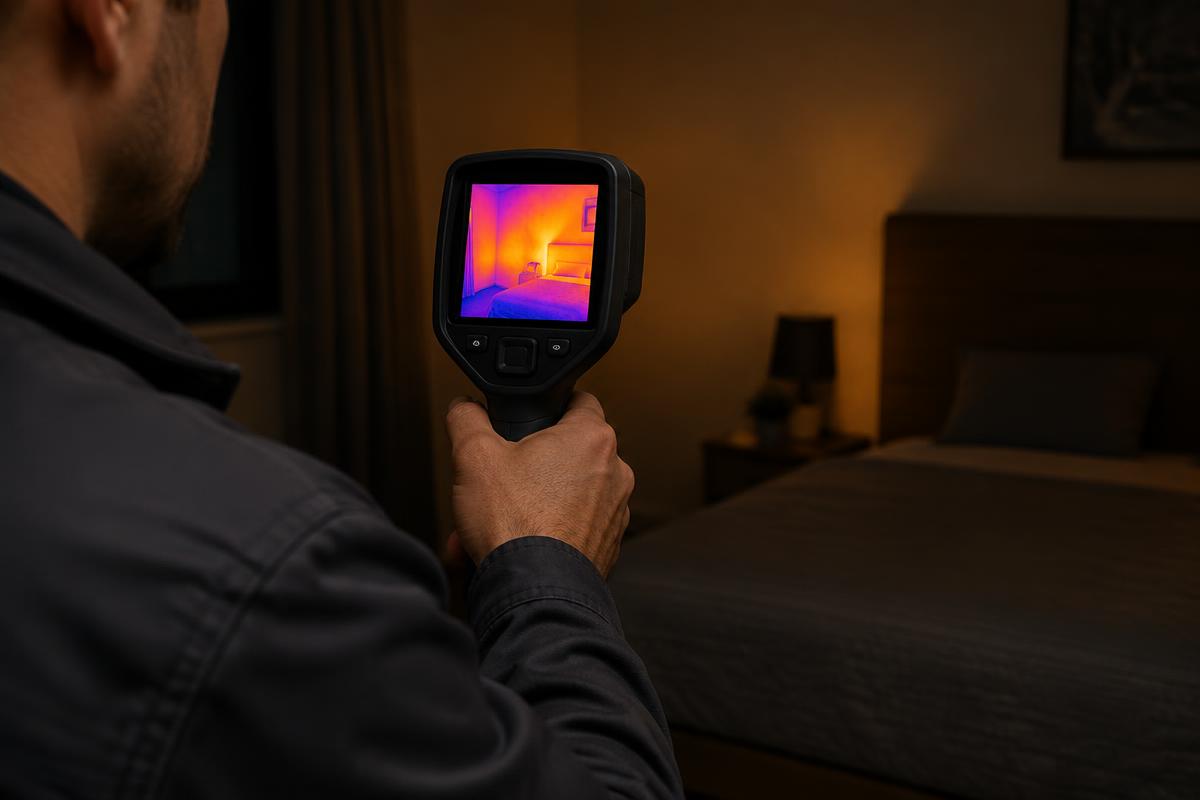
Monitoring uses active live thermal imaging cameras only. These provide live thermal views during the heating process, helping the team assess heat distribution across the treatment area. Heat treatment is a managed professional process, not simply a matter of turning on heaters and leaving a room unattended.
Heat is used to target bed bugs and their eggs, with no harmful chemicals as the primary treatment. Preparation, the building layout and access to the agreed areas remain important parts of the process. The guarantee should therefore be considered alongside the treatment plan, rather than as something separate from how the work is carried out.
Heat treatment also does not create a permanent barrier against insects arriving later in luggage, furniture or other belongings. That distinction helps explain why written guarantee terms matter. A later report needs to be assessed in context, rather than automatically treated as proof that the original work failed or that a new introduction occurred.
Preparation and its relationship to your cover
Preparation instructions help make the property suitable for the planned treatment. Follow the instructions supplied for your booking rather than a generic checklist found elsewhere. Different properties and possessions can need different arrangements, and you should ask for guidance if an instruction is difficult to follow or conflicts with a building rule.
Avoid moving potentially affected belongings into untreated rooms, communal corridors or another home without advice. Moving items can complicate the situation by carrying bed bugs away from the planned treatment area. Tell the company about anything already relocated so the assessment reflects what has actually happened, not just the property's current appearance.
Heat-sensitive belongings, medicines, pets and other practical concerns should be discussed before the visit. Do not guess which possessions should remain or be removed. The preparation guidance should explain the required arrangements, and any uncertainty should be resolved before equipment is brought into the property.
Ask specifically whether preparation duties form part of the guarantee conditions and what happens if something cannot be completed. It would be misleading to claim that every preparation problem automatically cancels cover. Equally, it would be unwise to assume that preparation has no bearing on eligibility or the response to later activity.
- Read the preparation instructions supplied for your booking.
- Ask about heat-sensitive possessions and medicines.
- Confirm arrangements for occupants and pets.
- Report belongings moved from affected rooms.
- Explain any preparation tasks you cannot complete.
- Check how preparation requirements relate to the guarantee.
Planning access in flats, hotels and converted buildings
For many London bookings, building access is as important to planning as the room layout. Let the company know about parking restrictions, loading arrangements, stairs and lift availability. If equipment must pass through a shared entrance, explain any rules governing its use so those requirements can be considered before the visit.
Concierge teams, managing agents and reception staff may need advance notice of the work. Establish who can authorise access and who will be available to open the relevant areas. This is particularly useful where the person booking the treatment does not live at the property or cannot attend.
Hotels and frequently occupied accommodation should provide accurate information about affected rooms, recent room changes and known signs elsewhere. Guest privacy still matters, but the treatment assessment needs a reliable picture of activity. Avoid narrowing the discussion to a single room if there are relevant reports from adjoining accommodation.
These arrangements do not create additional guarantee terms by themselves. Their purpose is to help the agreed work proceed as planned. If an access restriction could change the treatment scope, ask for its effect on the booking and guarantee to be clarified before proceeding, rather than relying on an informal assumption.
What to expect after the treatment
After treatment, follow the aftercare and re-entry guidance supplied for your property. Do not assume that the usual three-to-six-hour heating period tells you when occupants can return. Heating time and the arrangements for safely handing the property back are different matters, and the team should provide the relevant instructions.
Keep any treatment records and guarantee information somewhere easy to find. A simple record of the treatment date, covered areas and subsequent observations can be useful if you need advice later. There is no need to turn everyday life into a constant inspection, but clear information is more helpful than memory alone.
Bites or skin irritation on their own cannot reliably establish whether live bed bugs remain. Skin reactions can have other causes, and people's responses to bites vary. If you notice marks after treatment, report the concern calmly and describe any additional evidence rather than concluding immediately that the treatment has failed.
Old spotting, shed skins or other traces may also be difficult to interpret without context. Ask the company how to monitor the treated rooms and distinguish existing evidence from a new finding. Follow the agreed aftercare approach before introducing extra pest-control products or moving furniture in response to uncertainty.
How to report suspected activity during the six months
If you suspect bed bug activity during the guarantee period, contact Bed Bug Heat Solutions UK through its published contact channels and refer to your booking. Report the concern promptly, following any notification requirements in your written terms. You do not need to decide the cause yourself before asking the company to review what you have found.
Useful information includes the date of the observation, the room involved and whether you saw a live insect or only marks or debris. Clear photographs can help where they are possible to obtain. If an insect can be safely contained without spreading it, ask the company whether retaining it would assist identification.
Explain any relevant changes since treatment, such as travel, incoming second-hand furniture, room changes or reports from neighbouring accommodation. Sharing these details is not an admission that you caused the problem. It helps the company understand the circumstances and consider the report against the agreed scope and guarantee conditions.
Ask what happens next and whether any proposed inspection or work falls within the guarantee. Do not assume an automatic free repeat treatment, a particular attendance date or a fixed response time unless confirmed for your case. Keep a record of the advice given and follow instructions about managing the affected area.
- Find your booking and guarantee details.
- Record when and where the suspected activity appeared.
- Take clear photographs if practical.
- Describe live sightings separately from skin reactions.
- Mention relevant changes since treatment.
- Confirm the next steps and any potential costs.
Understanding recurrence and a new introduction
One of the most important guarantee questions is how the written terms deal with continuing activity and a new introduction. These are different possibilities, but the distinction cannot always be made from a brief description. A live insect found after treatment needs consideration of the timing, location, treatment scope and wider circumstances.
Frequently occupied London accommodation can involve regular arrivals of people and belongings. Luggage, used furniture and items moved between rooms may create opportunities for bed bugs to enter a treated space. This does not mean every later sighting is a new introduction, and it should not be used as a shortcut around assessing a concern.
Similarly, a report from a neighbouring flat does not prove where insects in your home originated. Building-level issues may require discussion with a landlord, managing agent or accommodation operator. Ask what can reasonably be assessed within your property and whether wider coordination is recommended before assuming the problem can be addressed room by room in isolation.
Before booking, ask how these situations are defined and handled under the guarantee. If a later concern is considered outside cover, request a clear explanation tied to the written conditions. Understanding the reasoning allows you to make an informed decision about further action without confusing a treatment guarantee with permanent protection against reintroduction.
Booking with a clear understanding of the guarantee
A useful booking discussion brings together the infestation history, property layout, access arrangements and guarantee terms. Tell the company where signs have been found, what action has already been taken and whether relevant rooms are occupied or inaccessible. This gives the assessment a sound starting point and reduces the risk of an unsuitable scope.
Bed Bug Heat Solutions UK serves England and Wales, including London, with over 40 years of hands-on pest-control experience. The company is fully insured and RSPH Level 2 certificated. These credentials provide background when choosing a provider, but they do not replace the need to read the terms of your individual treatment.
The central treatment facts are controlled industrial heat of 60–65 degrees C across the whole treatment area, a heating period usually lasting three to six hours, and monitoring using active live thermal imaging cameras only. The six-month guarantee applies to qualifying treatments, with the written conditions establishing how cover works for the agreed booking.
Before proceeding, make sure you can explain in plain language what is being treated, whether the work qualifies and whom to contact if signs return. If any of those points remain unclear, ask for clarification. A well-understood guarantee provides a practical route for raising concerns rather than an expectation based only on a headline.
Useful next steps
Frequently asked questions
Six-month guarantee
Qualifying treatments are covered for six months. Send your details for a free assessment.
More from the blog
How Long Does Bed Bug Heat Treatment Take?
Read the full guide: How Long Does Bed Bug Heat Treatment Take?